Bharat Future City Hyderabad: Complete Guide to Master Plan, Infrastructure and Investment
An evidence-led analysis of Telangana's proposed fourth city, FCDA jurisdiction, connectivity corridors, execution milestones, and property buyer due diligence (Research Reference Date: 28 November 2026).
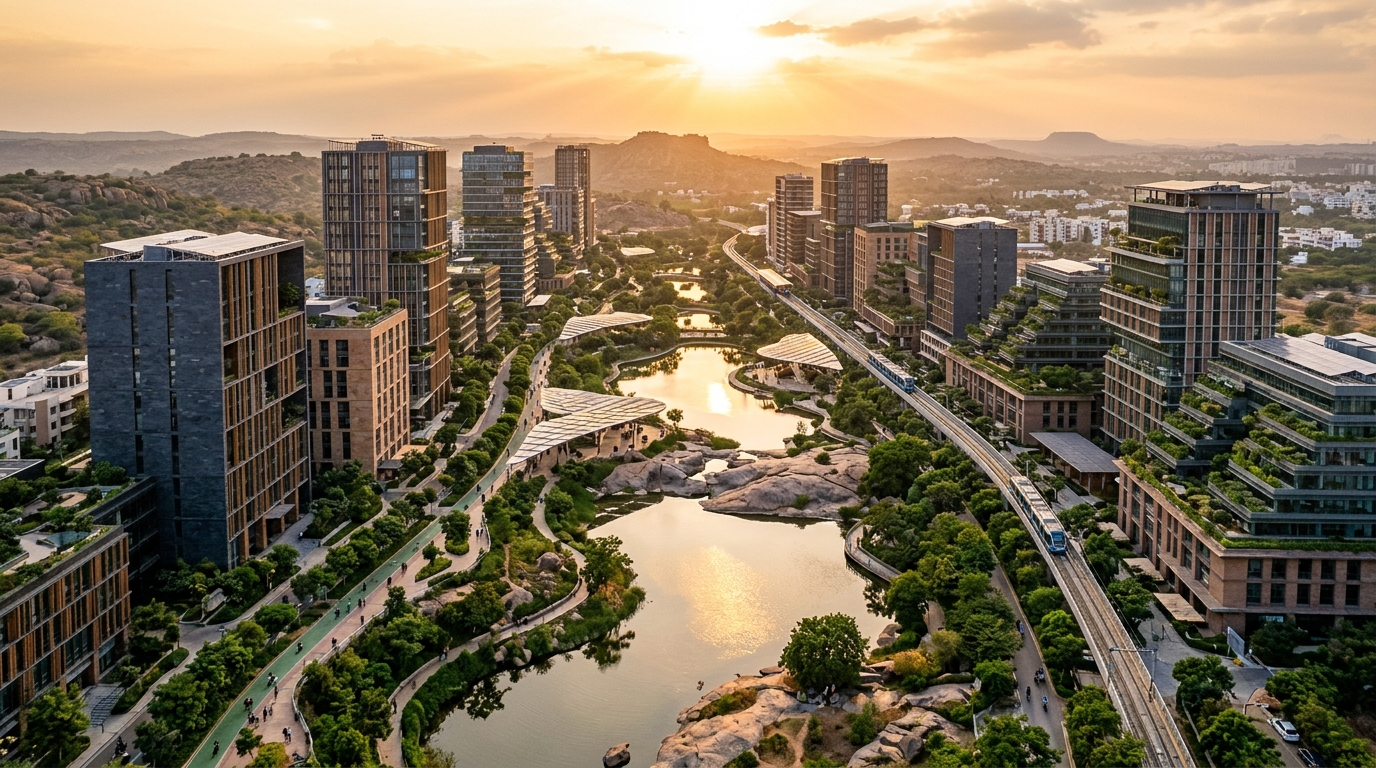
As of 28 November 2026, Bharat Future City—often referred to as Hyderabad's proposed Fourth City alongside Hyderabad, Secunderabad, and Cyberabad—has become one of the most closely watched greenfield urban initiatives in Telangana. Around Mucherla, Meerkhanpet, and the wider Srisailam–Nagarjuna Sagar southern growth belt, land announcements, institutional blueprints, and marketing claims frequently move faster than statutory approvals on the ground.
For residential homebuyers, plot purchasers, landowners, and NRIs evaluating Hyderabad's southern suburbs, separating officially notified facts from reported policy proposals and speculative marketing claims is essential before committing capital.
Quick Answer: What Is Bharat Future City?
Bharat Future City is a greenfield urban-industrial city proposed by the Government of Telangana on Hyderabad's southern outskirts, governed by the statutory Future City Development Authority (FCDA) constituted under G.O.Ms.No.69 (12 March 2025) across roughly 765 sq km covering 56 revenue villages in 7 mandals of Rangareddy district. Positioned around Mucherla and Meerkhanpet roughly 60 km from central Hyderabad, it combines reported proposals for an AI City, life sciences, skills education, clean manufacturing, and ten compact net-zero townships. As of 28 November 2026, full master-plan execution and multi-modal transit remain phased, multi-decade undertakings.
Why Is Telangana Developing a Fourth City?
Greater Hyderabad's rapid IT, financial, and residential expansion has concentrated heavily along its western crescent—spanning HITEC City, Gachibowli, Financial District, Kokapet, Tellapur, and Nanakramguda. While West Hyderabad continues to anchor high-density residential and commercial demand, land constraints, congestion, and infrastructure load inside the core Outer Ring Road (ORR) have pushed state planners to look outward.
Against Telangana's broader long-term economic ambition—linked in state policy narratives to reaching a one-trillion-dollar state economy by 2034—planners have positioned Bharat Future City as a new planned urban-economic engine south of the ORR. The stated strategic goals include:
- Balanced regional growth: Redirecting future industrial, technology, healthcare, and residential expansion toward southern Rangareddy district rather than overloading West Hyderabad alone.
- Planned greenfield zoning: Designing mixed-use employment and residential districts from scratch around transit, water resilience, and decarbonisation rather than retrofitting congested legacy layouts.
- Repurposing existing state land assemblies: Redirecting substantial tracts earlier assembled in the Mucherla–Yacharam belt toward non-polluting AI compute, education, life sciences, and clean-tech uses.
Where Is Bharat Future City Located?
Understanding exact statutory boundaries prevents one of the biggest mistakes buyers make in South Hyderabad: assuming every project marketed as "near Future City" sits inside the notified FCDA planning area.
Based on Telangana Municipal Administration & Urban Development (G.O.Ms.No.69, dated 12 March 2025) notifications and credible regional reporting:
- District & Core Anchor: Southern Rangareddy district, anchored around Mucherla and Meerkhanpet, situated outside the Outer Ring Road (ORR) between the Srisailam Highway (NH-765) and Nagarjuna Sagar Highway corridors, roughly 60 km from central Hyderabad.
- Notified Jurisdiction: Approximately 765.28 sq km, spanning 56 revenue villages across 7 mandals (parts carved out from HMDA and DTCP planning jurisdiction so FCDA serves as the unified planning authority).
| Location Tier | Mandals / Micro-Markets | Verification Status (As of 28 Nov 2026) |
|---|---|---|
| Inside Official FCDA Notification (56 Revenue Villages across 7 Mandals) | Kandukur (18 villages incl. Mucherla, Meerkhanpet, Kandukur, Lemoor), Yacharam (17 villages), Ibrahimpatnam (8 villages), Kadthal (6 villages), Manchal (3 villages), Amangal (2 villages), Maheshwaram (2 villages: Thummaloor, Mohabatnagar) | Officially Confirmed under G.O.Ms.No.69 (12 March 2025); detailed sub-zone layouts remain subject to statutory master plan release |
| Immediate Gateway & Airport Edge | Shamshabad, Tukkuguda (ORR Exit 14), core Maheshwaram hardware/villa belt outside the 2 notified villages, Adibatla | Adjacent Corridors — benefit from ORR, RGIA proximity, and radial access, but not automatically inside the FCDA boundary unless specifically notified |
| Established West & Core ORR Residential Markets | Kokapet, Neopolis, Narsingi, Tellapur, Nallagandla | Not part of Bharat Future City — distinct mature West Hyderabad residential markets along the western ORR |
Important Geographic Rule for Buyers: Outside the two specifically notified Maheshwaram mandal villages (Thummaloor and Mohabatnagar), pockets of Maheshwaram, Tukkuguda, and Shamshabad act as adjacent connectivity gateways rather than core Future City sectors. Always verify the exact survey number, village revenue record, and competent planning authority (FCDA vs HMDA vs DTCP) before buying.
Bharat Future City Master Plan and Proposed Zones
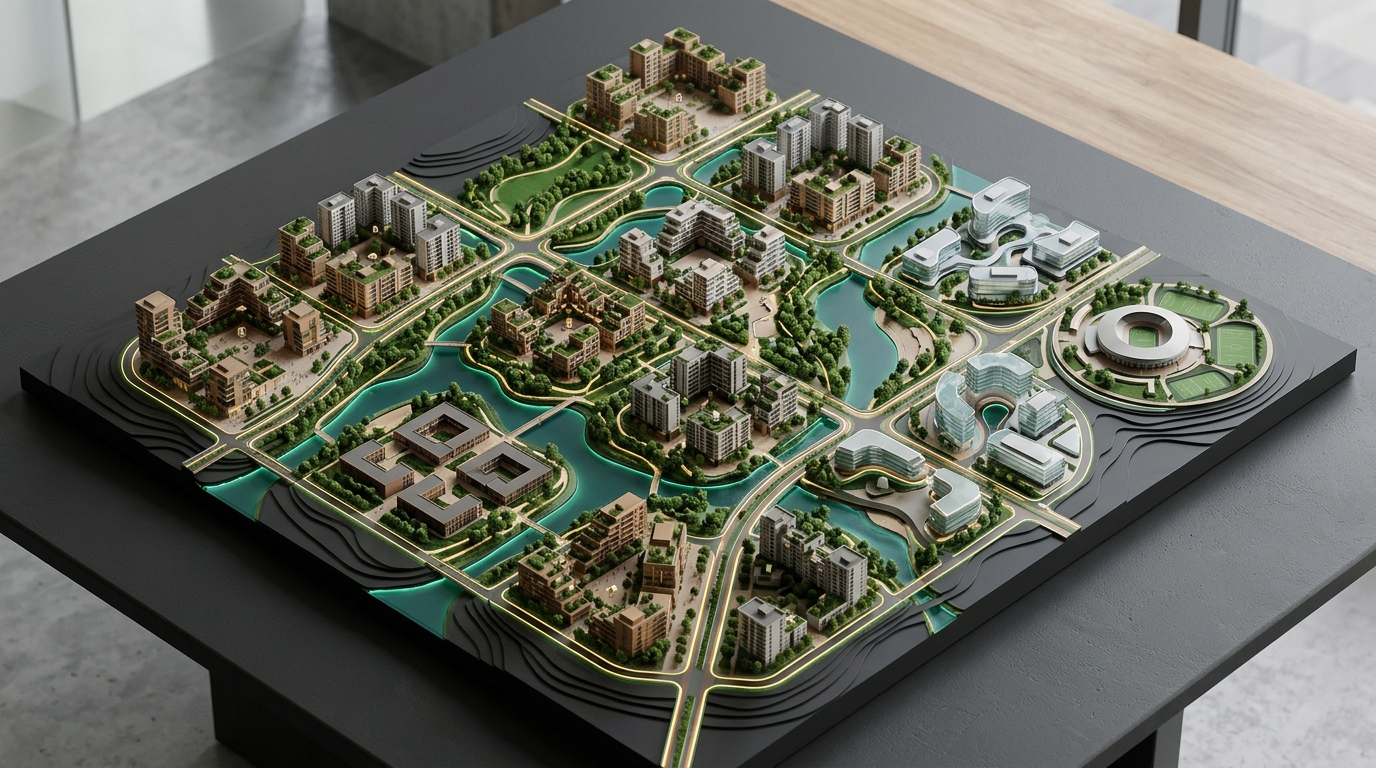
International planning consultants—reportedly led by Singapore-based DP Architects alongside advisory consortia—were engaged to structure the comprehensive urban blueprint. According to state outreach and the supplied summary research report (reference date 28 November 2026), the formal master plan was expected to be unveiled at the Invest Telangana Global Summit in December 2026.
Research Caution: Because our reference date is 28 November 2026, the December 2026 master plan has not yet been treated as a released, gazetted statutory document. Final sector boundaries, Floor Space Index (FSI) rules, green-buffer reservations, and road widths remain subject to official gazette notification and public objection processes.
Claim Verification Matrix: Confirmed vs Reported Proposals
| Component | Current Verification Category | What Buyers & Analysts Know Today |
|---|---|---|
| FCDA formation & 765 sq km / 56-village jurisdiction | Officially Confirmed | Constituted via G.O.Ms.No.69 (12 March 2025) under Telangana Urban Areas (Development) Act, 1975 |
| Young India Skills University (YISU) in Meerkhanpet | Officially Launched / PPP Initiative | Allocated ~57 acres in Meerkhanpet under PPP model with industry leadership to train talent across tech & manufacturing |
| FCDA HQ inauguration (10 June 2026) & Nov 2026 investor outreach | Reported in Supplied Brief & Regional Coverage | Institutional operationalization at Meerkhanpet and pre-summit investor engagement ahead of Dec 2026 Global Summit |
| AI City, Life Sciences/Health City, Sports & Entertainment Districts | Policy Proposal / Master-Plan Pillar | Designated thematic clusters inside DP Architects' master-plan scope; individual private project delivery depends on binding land allotment & construction |
| 10 net-zero townships, 1,500 km green streets, 1,000 km cycling/walking paths | Reported Planning Proposal | Aspirational urban-design targets reported in policy briefings; statutory phasing and capex schedules remain unverified |
| 158 km ORR water pipeline, circular grid & 2,000+ lake restoration | Reported Sustainability Proposal | Water-security & hydrology vision reported in regional planning briefs; engineering tenders and environmental clearances require ongoing tracking |
AI City and Industrial Development
A centerpiece of Bharat Future City is the proposed AI City and Technology Hub, positioned to support sovereign AI compute clusters, high-density green data centers, robotics R&D, and enterprise technology campuses. Credible industry and media reports indicate early state-level announcements around multi-gigawatt clean-powered data center infrastructure, life sciences and pharmaceutical research districts (re-anchored around non-polluting R&D), electric vehicle (EV) and clean manufacturing zones, and education/healthcare campuses.
From an urban economics perspective, Young India Skills University (YISU) plays a practical early role: establishing a physical anchor institution at Meerkhanpet creates an initial skills pipeline before larger private corporate campuses reach occupancy. However, investors should distinguish between Memoranda of Understanding (MoUs) signed at investor summits and actual ground-breaking with capital deployment and job creation.
Ten Proposed Smart Townships
Rather than enabling scattered, car-dependent peripheral sprawl, the reported urban concept emphasizes ten compact, net-zero-oriented townships built around a "walk-to-work" neighborhood model. In principle, each township pairs residential housing—including planned affordable housing components—with neighborhood retail, civic clinics, schools, and transit stops.
For housing markets, compact township planning matters because residential demand only becomes self-sustaining when employment nodes, schools, and daily amenities arrive concurrently. Developing residential plots or apartments far ahead of workplace occupancy risks multi-year vacancy and slow resale liquidity.
Roads, ORR and Regional Connectivity
Connectivity between existing Hyderabad employment centers, Rajiv Gandhi International Airport (RGIA) in Shamshabad, and the Mucherla–Meerkhanpet core is the primary operational test for Bharat Future City.
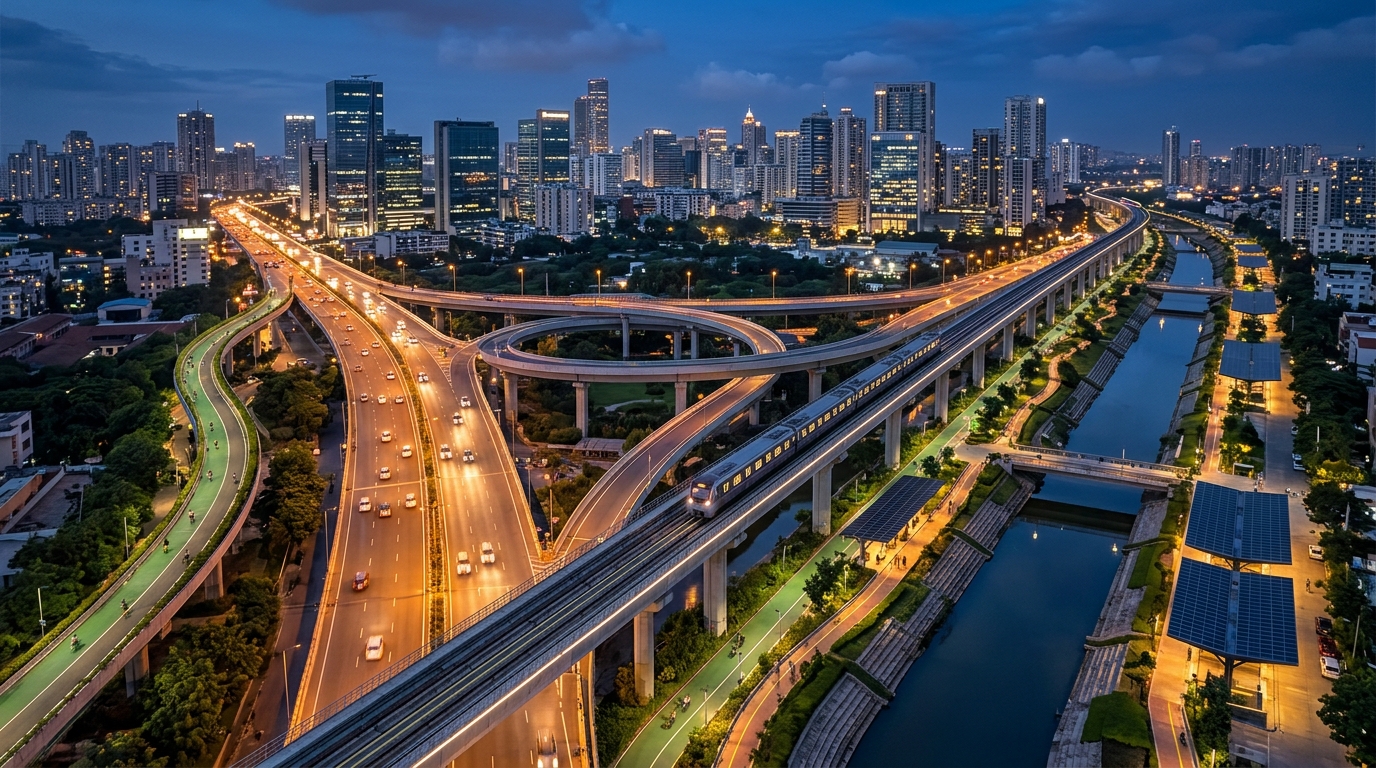
Key Connectivity Pillars Being Monitored
- Outer Ring Road (ORR) Spine: Exit 14 (Raviryal / Tukkuguda) serves as the nearest high-capacity expressway hinge connecting West Hyderabad's Financial District and airport directly toward Srisailam Highway and Meerkhanpet.
- Greenfield Radial Corridor (Ratan Tata Greenfield Radial Road / Radial Road 1): Proposed high-speed multi-lane arterial highway linking ORR Exit 14 (Raviryal) through Mucherla toward Amangal and the planned Regional Ring Road (RRR).
- Regional Ring Road (RRR – South Corridor): Land acquisition steps for the southern RRR stretch in Rangareddy and Vikarabad districts intersect long-term regional freight and peripheral access, though full multi-year construction completion remains ahead.
- Proposed Airport–Future City Metro Link: Hyderabad Airport Metro Ltd (HAML) has prepared Detailed Project Report (DPR) proposals for an approximately 40-km metro extension linking Shamshabad Airport (RGIA) to Meerkhanpet / Young India Skills University—subject to funding approvals, cabinet sanction, and construction timelines.
- Internal Active Mobility Targets: Reported proposals include 1,500 km of green streets and 1,000 km of dedicated walking and cycling corridors structured around Transit-Oriented Development (TOD).
Water Infrastructure and Lake Protection
Southern Rangareddy lies in a semi-arid Deccan plateau watershed where seasonal tank systems and groundwater borewells historically supported agriculture. Scaling a net-zero metropolis for hundreds of thousands of future residents and high-cooling-load AI data centers requires verified bulk water security before high-density occupancy.
Reported sustainability components include:
- Roughly 158 km of water supply infrastructure linked with the Outer Ring Road corridor.
- A circular water grid aiming for 24x7 supply and 100% wastewater treatment and industrial/landscape recycling.
- Protection, desilting, and ecological restoration of more than 2,000 lakes and water bodies as sponge-city flood buffers and groundwater recharge basins.
Buyers evaluating layouts anywhere in this watershed should verify whether HMWR&SB / Mission Bhagiratha bulk water connections exist or whether developments currently rely exclusively on borewells and private water tankers.
Net-Zero and Sustainable Development
Promoted as one of India's first large-scale net-zero-oriented greenfield developments, the city concept emphasizes low-carbon district cooling, rooftop and utility solar integration, permeable pavements, green building certifications, electric public transit, and strict separation between non-polluting R&D zones and ecological buffer zones.
Until statutory Environmental Clearances (EC), zonal green-belt regulations, and binding municipal building bylaws are published under FCDA, buyers should treat "net-zero" as a planning framework rather than assuming every private layout marketed nearby adheres to green building or ecological buffer rules.
Digital Twin and Smart Governance
The planning vision also incorporates a unified urban observatory and digital twin—a geospatial data layer intended to track land parcels, utilities, traffic demand, lake Full Tank Levels (FTLs), drainage networks, and construction compliance in real time. Combined with Telangana's digital building-permission portal ([TG-bPASS](https://tgbpass.telangana.gov.in/)), transparent spatial governance could materially improve layout clarity once statutory master-plan layers are opened to public inspection.
FCDA: Development Authority and Responsibilities
The Future City Development Authority (FCDA), established via G.O.Ms.No.69 on 12 March 2025 under the Telangana Urban Areas (Development) Act, 1975, acts as the statutory urban planning and development authority for the notified 765 sq km zone.
Its core responsibilities include:
- Preparing and notifying the statutory master plan and zonal development plans.
- Enforcing land-use zoning, road alignments, and green/water buffer protections.
- Coordinating trunk infrastructure (radial roads, power, bulk water, drainage, transit corridors).
- Regulating layout permissions and building approvals in coordination with state portals (TG-bPASS and Telangana RERA).
Before purchasing any plot or project inside the 56 notified villages, buyers must confirm whether the layout holds valid FCDA (or prior valid HMDA/DTCP) approval rather than unapproved Gram Panchayat or agricultural sub-division papers.
Bharat Future City Execution Roadmap
(Analytical Execution Framework — NOT an Official Government Timeline)
Because greenfield megacities across India historically develop over 15–25 years, the supplied research framework outlines five indicative phases. These dates are analytical planning benchmarks—not legally binding government delivery deadlines:
| Analytical Phase | Indicative Period | Core Functional Focus | Critical Milestones Required |
|---|---|---|---|
| Phase 1: Foundation | 2025–2026 | Authority, legal framework & master planning | FCDA statutory setup, master plan finalisation, litigation-free land settlement |
| Phase 2: Enabling Infrastructure | 2027–2029 | Roads, water, power & drainage | Radial Road 1 execution, trunk water/power substations, storm drainage |
| Phase 3: Anchor Development | 2028–2032 | Employers & initial townships | YISU operations, initial AI/life-sciences campuses, first workforce housing |
| Phase 4: Scale-Up | 2032–2037 | Industrial districts, housing & transit | Rapid transit/metro operations, multi-township retail, schools & hospitals |
| Phase 5: Maturity | 2037 onward | Full operations & regional integration | Self-sustaining urban tax base, RRR integration, balanced job-to-housing ratio |
Critical-Path Dependency Analysis
Real estate value in greenfield cities follows a strict causal sequence:
Land Certainty → Trunk Infrastructure Readiness → Anchor Investment & Jobs → Mass Transit → Housing & Social Amenities → Sustainable Population Growth
When residential plots or apartments are sold aggressively at Phase 1 while trunk water, jobs, and public transit only arrive in Phases 3–4, buyers often experience underutilised townships, poor rental demand, and wide bid–ask spreads if they try to exit early.
Land Acquisition and Farmer Concerns
A nuanced understanding of land assembly is crucial here. Roughly 14,000+ acres repurposed for Bharat Future City originated from the earlier land assembly begun around 2018 for the proposed Hyderabad Pharma City across Mucherla, Yacharam, and Kandukur mandals. That acquisition generated over 150 High Court writ petitions from farmers raising concerns over agricultural livelihoods, environmental impact, and compensation parity between patta and assigned landholders.
To transition toward litigation-free development, state authorities have promoted revised rehabilitation and compensation packages—including monetary compensation alongside developed plot allotments (such as 121-sq-yard developed residential/commercial plots per eligible family) and skill-training commitments—while selectively notifying additional parcels (such as recent notifications around Mucherla/Kandukur for corporate requirements and RRR South Corridor alignments).
Takeaway for Private Buyers: Never purchase private agricultural or plotted land adjacent to notified government land banks without verifying Encumbrance Certificates (EC), Dharani / Bhu Bharati / Registration & Stamps title chain, and confirmation that the survey number is not under Section 11 / Section 19 Land Acquisition notification or pending High Court stay orders.
Investment and Financing Framework
Large greenfield cities require tens of thousands of crores in upfront trunk capex before municipal property taxes scale. The supplied research report outlines potential financing avenues—including land value capture (LVC), state budgetary capital allocation, Public–Private Partnerships (PPPs), green bonds, and multilateral development bank financing.
Investors should note carefully: these proposed instruments are analytical financing frameworks, not confirmed signed funding facilities. Execution speed between 2027 and 2032 will depend directly on state fiscal capacity, bond/PPP structuring, and private anchor co-investment.
Impact on Hyderabad's Real Estate Market
Bharat Future City introduces a distinct multi-decade southern vector alongside Hyderabad's established residential corridors:
- Established West Hyderabad ([Kokapet](https://www.naani.in/projects-in-kokapet), [Tellapur](https://www.naani.in/projects-in-tellapur), [Narsingi](https://www.naani.in/projects-in-narsingi)): Remains Hyderabad's primary high-rise luxury and ready/under-construction IT-adjacent market with mature schools, hospitals, and immediate rental yield. Bharat Future City is not a near-term substitute for families needing immediate commute proximity to Financial District or HITEC City.
- Airport & Outer South Gateways ([Shamshabad](https://www.naani.in/projects-in-shamshabad), [Tukkuguda](https://www.naani.in/projects-in-tukkuguda), Maheshwaram): Stand to experience earlier secondary spillover because they already connect via ORR Exit 14 and the airport hub.
- Core Future City Belt (Mucherla, Meerkhanpet, Kandukur, Yacharam, Kadthal): Driven largely by long-horizon land banking and open-plot speculation today, with end-user residential viability contingent on Phase 2–3 infrastructure delivery.
Explore verified Hyderabad listings across all residential projects or compare micro-markets in our Hyderabad real estate hub.
Property Investment Opportunities and Risks
Direct vs Indirect Real Estate Opportunities
| Asset Class | Connection to Bharat Future City | Key Opportunity Logic | Primary Risk Factor |
|---|---|---|---|
| Open Residential Plots (HMDA / FCDA / RERA Approved) | Direct inside notified non-restricted zones / Gateway belt | Lower entry ticket compared to West Hyderabad | Unapproved GP plots, speculative pricing ahead of trunk infrastructure, long holding horizon |
| Gated Villas & Low-Rise Communities | Indirect / Gateway (Tukkuguda, Maheshwaram, Shamshabad) | Lifestyle upgrade near RGIA & ORR without waiting 10 years for internal utilities | Social infrastructure & school density still maturing outside ORR |
| Apartments (2 & 3 BHK) | Primarily indirect in ORR gateways today; township-scale later | End-user affordability and rental demand once anchor campuses employ staff | Buying high-rise inventory before local employment triggers weak interim rental yields |
| Commercial & Retail / Logistics | Direct near radial junctions & RRR corridors | Long-term warehousing, airport cargo support, workforce retail | Uncertain tenant absorption if anchor office campuses slip beyond 2030 |
Core Investment Risks Every Buyer Must Weigh
- Speculative Pre-Infrastructure Pricing: Hype around "Fourth City" branding can push asking rates ahead of actual rentability, compressing realistic future gains.
- Planning Boundary & Land-Use Conversion Risk: Buying agricultural land or unapproved sub-divisions inside proposed green belts, FTL lake buffers, or future radial road alignments can result in demolition notices or frozen mutation.
- Litigation & Assigned Land Hazards: Pockets across Rangareddy district carry historic assigned-land, Inam, Waqf, or Pharma City acquisition disputes.
- RERA Non-Applicability / Exemption Traps: Small plot layouts below threshold limits or unapproved splits bypass [Telangana RERA](https://rera.telangana.gov.in/) consumer escrow protections.
- Liquidity Risk: In emerging peripheral corridors, exiting an open plot during a market slowdown often takes longer than exiting an apartment in an established hub like Kokapet or Tellapur.
What Buyers Should Verify Before Investing
Use this 7-step due-diligence checklist before paying any token advance in or around the Future City corridor:
- Exact Revenue Village & Survey Number Check: Confirm whether the parcel sits inside the 56 notified FCDA villages or an adjacent HMDA/DTCP jurisdiction—do not rely on brochure proximity maps.
- Statutory Layout & Building Approval: Verify final FCDA / HMDA / DTCP LP number and check whether RERA registration applies on [Telangana RERA](https://rera.telangana.gov.in/). Reject unregistered "under-process LP" promises.
- Land-Use & Master Plan Compatibility: Check Telangana [TG-bPASS](https://tgbpass.telangana.gov.in/) and revenue zoning to confirm non-agricultural conversion (NALA) and zero overlap with lake FTL/buffer zones, green zones, or proposed radial road/RRR acquisition alignments.
- 30-Year Legal Title & Encumbrance Certificate: Obtain certified ECs through the Telangana Registration & Stamps Department, plus verification of patta status, absence of assigned-land restrictions, and absence of High Court writ petitions.
- On-Ground Physical Utilities: Inspect actual internal blacktop roads, electricity lines, stormwater drainage, and verified water source—not just boundary stone pillars.
- Hold Horizon Stress-Test: Ensure your financial plan supports a 7–12+ year hold without relying on short-term flipping or guaranteed appreciation.
- Compare Alternatives Objective-First: If your priority is immediate self-use or near-term rental income within 2–4 years, evaluate established hubs via our 2 BHK flats guide or 3 BHK flats guide.
Challenges That Could Affect Project Delivery
Even well-designed greenfield city plans face structural execution headwinds:
- Farmer Settlement & Court Resolution: Clearing residual acquisition objections without stalling radial road right-of-way.
- Multi-Billion-Dollar Trunk Financing: Securing steady capital over 10–15 years across municipal cycles and political continuity.
- Bulk Water & Power Execution: Delivering 24x7 water supply and high-reliability clean power simultaneously for hyperscale data centers and residential townships.
- Private Anchor Conversion: Converting global summit MoUs into operational employers that create sustained white-collar and industrial jobs.
Important Milestones to Monitor (2026 Onward)
Smart buyers and institutional observers should track verifiable milestones rather than promotional headlines:
- Official gazette release and public spatial GIS map of the FCDA Comprehensive Master Plan (anticipated around/after December 2026).
- Tender awards, right-of-way handover, and physical earthwork on Radial Road 1 (Raviryal–Mucherla–Amangal) and RRR South Corridor.
- First-batch campus occupancy and private corporate construction starts around Young India Skills University (Meerkhanpet) and AI/life-sciences blocks.
- Formal Union/State budget sanction and construction commencement on the RGIA–Future City Airport Metro extension.
- Bulk water pipeline and electrical substation commissioning certificates.
Conclusion
Bharat Future City represents a bold, structurally important policy bet to build an ecologically planned fourth urban-economic pillar on Hyderabad's southern flank. Backed by the statutory Future City Development Authority (G.O.Ms.No.69), ~765 sq km of planning jurisdiction, initial skills-university land activation, and strategic linkages toward RGIA, ORR, and RRR, its long-term institutional framework is real.
At the same time, as of 28 November 2026, core master-plan zoning remains ahead of gazetted release, mass transit proposals remain pre-construction, and true city maturity spans well into the late 2030s. For homebuyers and investors, discipline beats hype: verify approvals independently, distinguish inside-boundary parcels from speculative outer villages, and align any investment strictly with your liquidity horizon.
Disclaimer: This article is intended for general informational and educational purposes. Bharat Future City's master plan, infrastructure proposals, land arrangements and implementation schedule may change. Buyers and investors should independently verify land title, approvals, legal status and government notifications before making property decisions.
Explore Hyderabad Properties with Objective Due Diligence
Planning to explore property opportunities around Hyderabad's upcoming growth corridors? Connect with Naani Projects to understand available residential properties, project approvals, and location-specific considerations before making a decision.